
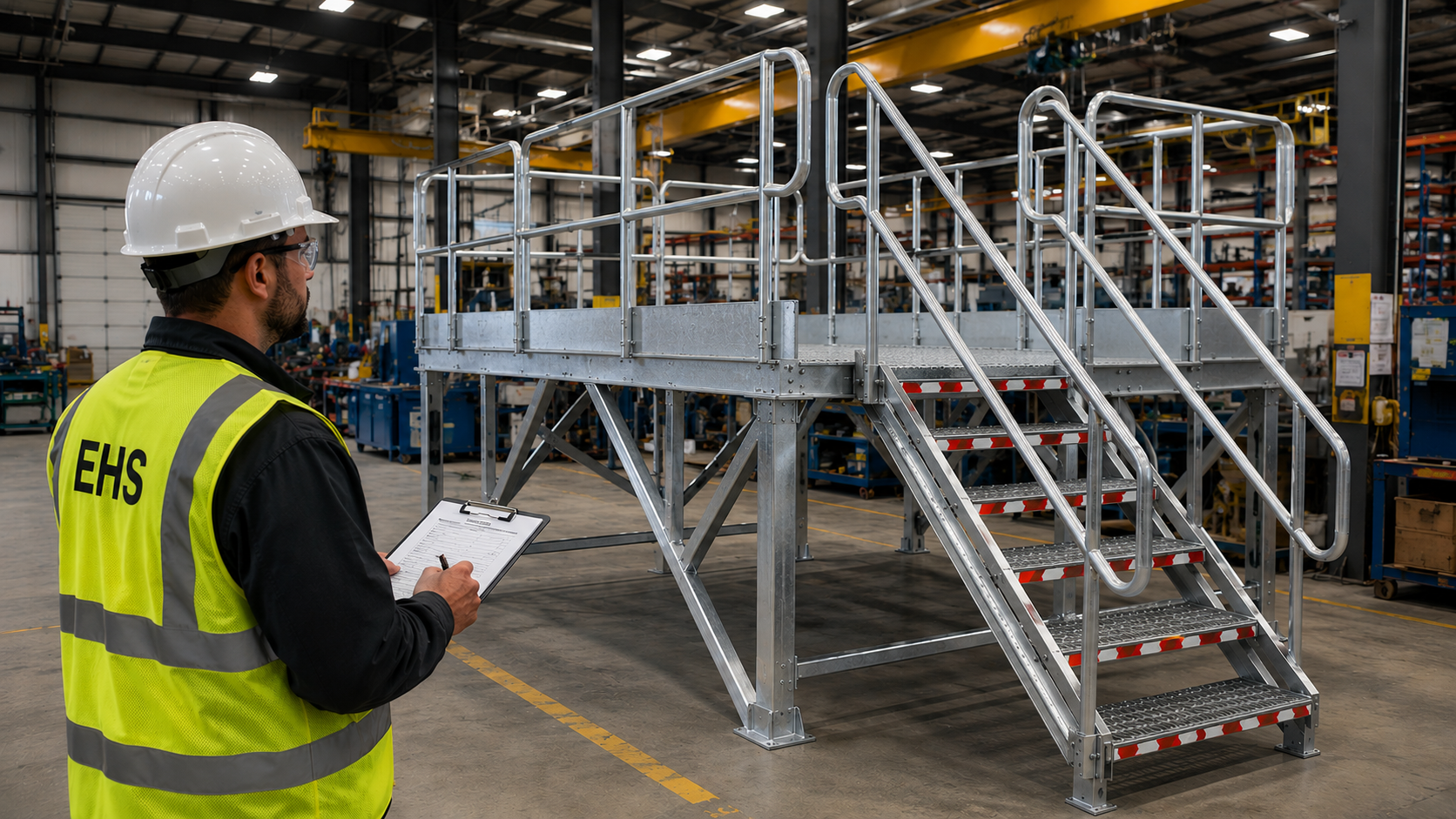
Safety Information
Practical Safety Starts Before The Work Begins
SAFE-T-FAB products are designed to support safer, more organized work on elevated platforms, guarded work areas, and industrial environments.
Every worksite, platform, and application is different. Before using any equipment, workers and supervisors should evaluate the platform structure, guardrail system, load requirements, work conditions, and applicable safety procedures.
SAFE-T-FAB products should always be used as part of a complete jobsite safety plan.
What Makes An Elevated Work Platform Safe
A safe elevated work platform does four things at once. It holds the load it will actually see, it keeps people from going over the edge, it lets them get on and off without doing anything acrobatic, and it keeps whatever they are carrying from landing on someone below.
Miss any one of those and the other three do not save you. A platform with perfect guardrail and a ladder bolted to the wrong side still puts a worker in a bad position every time they climb it. A platform rated for the crew but not for the 400 pound gearbox they set down on it is a platform that failed at the specification stage, not on the shop floor.
That is why we treat safety as a design question first and a procedure question second. Procedures depend on people behaving correctly every single day. Structure does not.
Important Safety Notice
SAFE-T-FAB products are designed to support safer work practices, but they do not necessarily replace required:
- Fall protection systems
- Personal protective equipment (PPE)
- Site-specific safety procedures
- Worker training
- OSHA compliance requirements
- Competent person inspections
Employers are responsible for ensuring that all work platforms, scaffolds, lifts, guardrails, and fall protection systems comply with applicable OSHA regulations before work begins.
View OSHA Fall Protection Requirements →
The Five Ways People Get Hurt On Elevated Platforms
Nearly every incident we hear about traces back to one of these.
1. Falls from an unprotected edge.
A missing rail, a removed rail section that never went back, a gap at a stair opening, or an open side that nobody thought counted because it faces a wall two feet away. Two feet is enough room to fall through.
2. Falls through an opening.
Ladderway openings, hatch openings, and removed grating panels. An opening in a walking surface is a fall hazard whether or not anyone plans to be near it.
3. Falls during access and egress.
Getting on and getting off is where most of the trouble is. Overreaching from a ladder, stepping across a gap between a platform and equipment, carrying parts with both hands on a stair, and climbing on the structure because the intended access is inconvenient.
4. Struck-by from dropped objects.
A tool, a fastener, or a part leaves the deck and finds someone below. This is the hazard that most often affects a person who was not even doing the work.
5. Slips and trips on the deck.
Hoses, cords, standing water, oil, ice, and stored material. The platform is a walking-working surface and gets held to the same housekeeping standard as the floor.
Design can eliminate the first two almost entirely. Design can reduce the third and fourth substantially. The fifth is mostly discipline, but deck selection and drainage help.
When Fall Protection Is Required
General industry, 29 CFR 1910.28(b)(1): protection is required at 4 feet above a lower level.
Construction, 29 CFR 1926.501(b)(1): protection is required at 6 feet.
Those are trigger heights, not design targets. We put guardrail on most platforms regardless of height, because a fall from 30 inches onto concrete with a tool in your hand still ends in an emergency room.
Work Through The Hierarchy, Not Around It
Eliminate the hazard. If the service point can be brought down to the operator, or the platform can be extended so nobody has to lean, the fall hazard goes away and stays away.
Use passive protection. Guardrail, toeboards, and covers work without anyone doing anything. No donning, no inspection of a harness, no tie-off point to find. This is where a well-designed platform earns its cost.
Use travel restraint. A system that physically prevents a worker from reaching the edge.
Use fall arrest. A harness, anchorage, and connector that stops a fall in progress. It only works if the anchorage is rated, the clearance below is calculated, and rescue is planned.
Administrative controls and training. Necessary, but the weakest layer on its own.
Passive protection is the layer we build. If a platform we design still needs harness use to be safe, we tell you that in writing rather than letting you find out later.
Guardrail Requirements In Plain Language
The height is the number everybody knows. The load is the number that actually gets people cited.
Top rail: 42 inches above the walking surface, plus or minus 3 inches.
Top rail strength: must withstand 200 pounds of force applied downward or outward within 2 inches of the top edge, at any point along the rail.
Deflection: under that 200 pound load, the top rail cannot deflect below 39 inches above the walking surface. Passing the load test is not enough if the rail folds down to 34 inches while it does it.
Midrail: installed midway between the walking surface and the top rail, unless there is a wall or parapet at least 21 inches high. Midrails must withstand 150 pounds.
Openings: no opening in the system may exceed 19 inches. That applies to the gap under the midrail, the gap above it, and the spacing of any balusters or infill.
Toeboard: at least 3.5 inches tall, no more than a quarter inch of clearance at the deck, capable of withstanding 50 pounds. Required where anyone or anything is below.
Surface and ends: the system has to be smooth enough that it does not cut hands or snag clothing, and rail ends cannot overhang a terminal post where they create a projection hazard.
Where Guardrail Systems Usually Fail
- A rail section removed for a maintenance access point that never gets reinstalled
- A chain used in place of a gate at an opening
- Undersized posts or posts spaced too far apart, which passes a visual check and fails the load test
- A midrail left out because a nearby wall looked tall enough
- A guardrail bolted to a deck that was never designed to take the moment from a 200 pound outward pull
- Accessories, cable trays, or stored material hung on the rail
If you can flex a top rail noticeably with one hand, it will not survive a 200 pound impact load. That is a good five second field check.
Safe Access And Egress
The platform is usually not the problem. Getting on and off it is.
Stair Or Ladder
| Situation | Better choice |
|---|---|
| Daily or multiple times per shift | Stair |
| Workers carry tools, parts, or samples | Stair |
| Long climb, more than about 12 feet | Stair with intermediate landings |
| Low traffic and no floor space available | Fixed ladder |
| Very tight footprint but regular traffic | Switchback stair or alternating tread stair |
| Emergency egress path | Stair |
A stair costs more and takes more floor space. It is still the right answer most of the time, because people carry things and people get tired.
Stair Geometry That Works
Standard stairs sit between 30 and 50 degrees from horizontal. Maximum riser is 9.5 inches, minimum tread depth is 9.5 inches, and both have to be uniform between landings. Uniformity matters more than most people realize. A single riser that is three quarters of an inch off from the rest is a trip hazard every time someone descends without looking down.
Minimum stair width is 22 inches between vertical barriers. Landings are at least as wide as the stair and at least 30 inches deep in the direction of travel. Headroom is 6 feet 8 inches from the leading edge of the tread.
Handrails go on any flight with at least three treads and four risers, mounted 30 to 38 inches above the tread nosing.
Openings And Gates
A ladderway or stairway opening in a guardrail needs either a self-closing gate or an offset that keeps a person from walking straight into the hole. Self-closing gates are the better answer because they do not depend on anyone remembering.
Chains, ropes, and removable rail sections are all things somebody eventually leaves open.
Fixed Ladders
OSHA allows rungs spaced 10 to 14 inches on center as long as the spacing is uniform. We use 12 inch spacing at all times on ladders we build, and we set the first rung between 0 and 14 inches maximum off the ground. That is our internal rule, not a code minimum, and it means a climber's feet land where they expect on every ladder that leaves here.
Minimum clear width of 16 inches between side rails. At least 7 inches of clearance behind the rung centerline to the nearest permanent object, which is where conduit and pipe runs cause problems on retrofits. Side rails extend 42 inches above the landing on a through ladder.
Any fixed ladder extending more than 24 feet requires a ladder safety system or a personal fall arrest system. Cages and wells no longer count as fall protection on their own. New and replaced ladders had to comply as of November 19, 2018, and everything remaining has to comply by November 18, 2036. If you are replacing part of an old caged ladder now, that section triggers the upgrade now.
Key Safety Considerations
1. Confirm Compatibility Before Use
Before installing any accessory or add-on, verify that it is compatible with the specific platform, scaffold, lift, or guardrail system being used.
Accessories should never interfere with:
- Guardrails
- Toe boards
- Access gates
- Fall protection systems
- Platform stability
- Worker movement
- Emergency access or egress
If there is uncertainty regarding compatibility, contact SAFE-T-FAB before use.
2. Do Not Overload Platforms Or Guardrails
Accessories, tools, stored materials, and mounted equipment add weight to the work platform and guardrail system.
Always:
- Follow stated load limits
- Confirm platform capacity
- Distribute weight appropriately
- Avoid concentrated loading on rail systems
- Use only approved attachment methods
Never assume a guardrail or platform is designed to support additional equipment unless verified by the platform manufacturer or a qualified professional.
3. Maintain Required Fall Protection
Accessories should never be installed or used in a way that removes, weakens, bypasses, or obstructs required fall protection systems.
Workers should always maintain proper fall protection procedures and comply with site-specific safety requirements.
OSHA walking-working surface standards generally require guardrail systems to maintain proper height and structural integrity.
View OSHA Walking-Working Surface Standards →
4. Keep Work Areas Organized
Clean and organized platforms help reduce trip hazards, dropped-object risks, excessive reaching, unnecessary movement, tool loss, and worker fatigue.
A safer setup allows workers to:
- Keep stable footing
- Avoid leaning over guardrails
- Maintain clear walking paths
- Access tools without awkward body positions
- Minimize clutter on the platform surface
5. Inspect Before Each Use
Before each use, inspect all equipment and attachment points for signs of damage or wear.
Inspect for:
- Cracks
- Bent components
- Loose hardware
- Corrosion
- Missing fasteners
- Improper fit
- Sharp edges
- Signs of overload or impact damage
Do not use damaged or modified products.
6. Stabilize Mobile Equipment Before Anyone Climbs
Mobile platforms and rolling stairs add a hazard that fixed equipment does not have. They move.
Before use:
- Position on level, solid floor. Not on a floor joint, drain grate, or expansion gap
- Engage all locking casters, or set the spring-loaded casters down
- Confirm nothing is loaded on the deck that will shift the center of gravity when someone climbs
- Check that outriggers or stabilizers, if the unit has them, are deployed
Never:
- Move a unit with a person on it
- Move a unit with tools or material still on the deck
- Use a forklift to push or reposition a unit that was not designed for it
- Climb a unit whose casters will not lock
7. Account For The Environment
Outdoor and washdown environments change the risk profile.
- Ice and snow accumulate on solid deck plate. Open grating sheds it
- Standing water on a solid deck freezes overnight and is invisible at 6 a.m.
- Wind loading matters on tall exterior structures and on anything with a solid wind-catching surface
- Chemical exposure attacks coatings first and fasteners second
- Freezer and cold storage applications change material behavior and make ice control a daily task
- Vibration from nearby equipment loosens fasteners over time
Tell us the environment during design. Deck selection, finish, and fastener choice all change with the answer.
8. Control What Is Stored On The Platform
A work platform is not a shelf. Material stored on a deck consumes rated capacity, blocks walking paths, creates trip hazards, and blocks the toe board from doing its job.
If a platform needs permanent storage, that storage should be designed in with its own rated capacity, not added later by whoever needed somewhere to put it.
Safe Use Guidelines
SAFE-T-FAB equipment should only be used as intended and according to product instructions.
Always
- Verify the platform is rated for the people, tools, and material going on it
- Verify secure attachment of any accessory before loading it
- Confirm casters are locked and the unit is on level ground before climbing
- Maintain three points of contact on any ladder
- Keep both hands free on stairs and use a hoist, tool bag, or hand line for material
- Face the ladder when climbing up or down
- Keep guardrail, gates, and toe boards in place and functional
- Keep walking paths clear from the access point to the work point
- Inspect before each use and remove damaged equipment from service immediately
- Follow all product instructions and stay within stated load ratings
- Store portable and mobile equipment in a clean, dry place
- Report any modification, damage, or near miss the same day it happens
Never
- Use a platform, guardrail, or accessory as a fall protection anchor point unless the documentation specifically rates it as one
- Overload a guardrail or platform system
- Modify, weld, drill, cut, bend, or alter equipment without written approval from the manufacturer
- Remove a guardrail section and leave the opening unprotected
- Substitute a chain or rope for a gate
- Stand on a guardrail, midrail, toe board, or the top step of a rolling ladder
- Move a mobile unit with a person or load on it
- Block emergency access or egress paths
- Use damaged, corroded, or improperly repaired equipment
- Bridge a gap between a platform and equipment with a plank, pallet, or piece of grating
- Let a temporary fix become permanent
Dropped Object Awareness
Dropped tools and materials create serious hazards for workers below elevated work areas. Anything at height is a potential dropped object, including things that seem too heavy to fall and things that seem too small to matter. A three ounce fastener from 40 feet still hits hard.
Passive Controls, Built Into The Structure
- Toe boards at every open edge where anyone can pass below
- Screening or paneling above the toe board where material is stacked higher than 3.5 inches
- Solid deck instead of open grating where nothing can be allowed through
- Debris netting on tall or exterior structures
Active Controls, Applied By The Crew
- Tool lanyards and tethering on anything carried above ground level
- Closed tool bags and buckets instead of open trays
- Hoisting material up rather than carrying it
- Securing loose hardware in containers before setting them down
Zone Controls, Applied By The Site
- Barricading and signing the area below the work
- Scheduling overhead work when the area below is clear
- Communicating between the crew above and anyone working below
Grating size matters here. Open grating that lets a dropped socket pass through is fine over an empty floor and a serious problem over a walkway.
Inspection: Three Levels
Before each use, by the user. A visual walk-around. Takes under a minute. Looking for anything obviously wrong: damage, missing hardware, a loose rail, a caster that will not lock, debris on the deck.
Periodic, by a competent person. Scheduled and documented. Frequency depends on use and environment. Heavy daily use in a corrosive environment gets looked at far more often than a mezzanine stair in a dry warehouse.
After any incident or modification. Any impact from a forklift, any overload event, any weld repair, any relocation, any structural change. Nothing goes back into service on the assumption that it is probably fine.
What To Look At, By Component
Welds. Cracks at the toe of the weld, corrosion at the weld line, any weld that has been repaired in the field without engineering review.
Fasteners. Missing, loose, backed out, corroded, or wrong grade. Look for witness marks and rust streaks below a bolted joint, which usually means movement.
Guardrail. Flex under hand pressure, loose posts, bent members, missing midrails, gaps larger than 19 inches, damaged gates that no longer self-close and latch.
Deck and treads. Worn or flattened serrations on Grip Strut, corrosion through a plate deck, bar grating that has lifted from its clips, gaps at deck joints, oil or coating buildup that has made a surface slick.
Stairs. Loose treads, worn nosings, uneven risers from a settled base, handrails that spin in their brackets.
Ladders. Loose or bent rungs, corrosion at the mounting brackets, obstructions that have crept into the climbing space, anything blocking the required 7 inch clearance behind the rungs.
Casters and mobility. Cracked wheels, flat spots, seized swivels, locks that no longer hold, bent axles.
Anchors and base. Cracked or spalled concrete around anchors, loose anchor nuts, base plates that have lifted, corrosion at the floor line where water sits.
Finish. Chipped coating with rust starting underneath, galvanizing that has been welded or drilled through without touch-up.
Remove From Service Immediately If You Find
- Any cracked weld or cracked structural member
- A guardrail that moves under hand pressure
- Section loss from corrosion in a load-carrying member
- A missing or non-functional gate at an opening
- Casters that will not lock on a mobile unit
- Evidence of an overload or impact event
- Any unauthorized field modification
Tag it, pull it out of the work area if you can, and get it evaluated before anybody climbs it again.
Training And Site Procedures
All workers should receive appropriate training regarding platform safety, scaffold safety, fall protection, proper equipment installation, load awareness, inspection procedures, and site-specific hazards.
Site supervisors should verify that workers understand both the product instructions and the project safety plan before work begins.
What Training Should Actually Cover
Training under 29 CFR 1910.30 has to be given by a qualified person and has to be specific to the equipment and the hazards on your site. A generic video does not do it.
- The fall hazards that exist in that specific work area
- Correct use of the specific guardrail systems, gates, ladders, and platforms in use
- Load ratings and how to know when something is close to them
- The correct way to get on and off, including material handling on stairs and ladders
- How to inspect before use and what to do when something fails inspection
- Who has the authority to take equipment out of service, and how to do it
- Rescue procedures where personal fall arrest is used
Retrain When
- Equipment or the work area changes
- A worker shows they do not understand or retain the procedure
- After any incident or near miss
- When a new hazard is introduced into the area
Document who was trained, when, on what equipment, and by whom. If it is not written down it does not exist during an inspection.
Daily Pre-Use Checklist
Before using SAFE-T-FAB equipment, confirm:
- Equipment is the right type and rating for the task
- Platform capacity verified against the people, tools, and material going up
- Mobile units are on level ground with all casters locked
- Guardrails, midrails, and toe boards are present, secure, and undamaged
- Gates close and latch on their own
- Deck and treads are clean, dry, and free of oil, ice, and debris
- Walking paths are clear from access point to work point
- No cracked welds, loose fasteners, or bent members visible
- Accessories are securely attached and within their own ratings
- Access ladder or stair is clear and undamaged
- Nothing below the work area that could be struck by a dropped object
- Tools are tethered or contained
- Workers are trained on this specific equipment
- Site-specific safety procedures and permits are in place
Periodic Documented Inspection Checklist
- All welds inspected for cracking and corrosion
- All structural members checked for deformation and section loss
- Bolted connections checked for tightness, corrosion, and evidence of movement
- Guardrail system load-checked by hand at multiple points along each run
- Deck attachment verified, including grating clips
- Stair treads, nosings, and handrail brackets checked
- Ladder rungs, brackets, and climbing clearances verified
- Casters, locks, swivels, and stabilizers checked on mobile units
- Anchors and base plates checked, including the concrete around them
- Coating condition assessed and corrosion documented
- Rated capacity signage present and legible
- Findings recorded with date, inspector name, and corrective actions
- Follow-up date assigned for any open item
Safety Starts With Planning
A safer work environment begins with preparation, organization, and awareness.
Proper planning can help reduce clutter, unnecessary movement, dropped-object hazards, improper loading, worker fatigue, and inefficient workflows.
SAFE-T-FAB products are designed to support practical, organized, and efficient elevated work environments when used correctly and responsibly.
OSHA And Industry Resources
OSHA Resources
Additional Industry Resources
Looking for product instructions, load rating information, or an inspection checklist for equipment we built? Call us at 888-864-9853 and we will send what you need for your specific unit.
Frequently Asked Questions
Are SAFE-T-FAB products intended to be fall protection anchor points?
No. SAFE-T-FAB products are not intended to serve as fall arrest anchor points or tie-off devices unless explicitly stated in product documentation. An anchorage has to be engineered and rated for the arrest forces, and those forces are far higher than most people assume.
Can accessories be used on any guardrail system?
Not necessarily. Compatibility depends on the platform, guardrail dimensions, load requirements, and application. Always verify compatibility before use.
Do accessories affect guardrail load ratings?
Additional loads can affect guardrail systems and platform performance. Users are responsible for confirming that all systems remain within allowable load capacities.
How often should accessories be inspected?
Products should be visually inspected before each use and removed from service if damaged, worn, or improperly functioning.
What height requires a guardrail?
Four feet above a lower level in general industry, six feet in construction. We include guardrail on most platforms below those heights anyway.
Is a 42 inch rail always compliant?
The height alone does not make it compliant. The system also has to withstand 200 pounds without deflecting below 39 inches, carry a midrail unless there is a wall or parapet at least 21 inches high, keep all openings under 19 inches, and stay free of projection and snag hazards.
Can I use a chain instead of a gate at a ladder opening?
No, in practical terms. A chain will not hold 200 pounds without deflecting and leaves an opening much larger than 19 inches. Use a self-closing gate or an offset entry.
Does a platform under four feet need guardrail?
Not by the letter of the general industry standard. In practice we usually add it anyway. The cost difference is small and the fall from 40 inches onto concrete is not.
Who is responsible for platform compliance, the manufacturer or the employer?
The employer. We design and build to the standard and tell you what the equipment is rated for. The duty to have compliant walking-working surfaces, trained workers, and a fall protection plan sits with the employer under 29 CFR 1910.
How often does an industrial platform need to be inspected?
Before each use by the user, and on a documented periodic schedule by a competent person. There is no single universal interval. Heavy use, corrosive environments, and mobile equipment all shorten it.
What is a competent person?
Someone capable of identifying existing and predictable hazards and who has the authority to take prompt corrective action. Authority is the part people forget. Someone who can spot the problem but cannot stop the work is not a competent person.
What rung spacing do you use on fixed ladders?
OSHA requires uniform spacing between 10 and 14 inches on center. We build to 12 inches every time, with the first rung set between 0 and 14 inches maximum off the ground. Uniformity is the part that matters most in the field. A ladder with one odd rung is a ladder somebody misses a step on.
When does a fixed ladder need a ladder safety system?
When it extends more than 24 feet above a lower level. Cages and wells no longer satisfy the requirement on their own, and the final deadline for all remaining ladders is November 18, 2036.
Can we just add fall arrest instead of guardrail?
Sometimes, and it is a worse answer in most cases. Fall arrest depends on the harness being worn and inspected, a rated anchorage, enough clearance below to stop the fall, and a rescue plan. Guardrail works whether or not anybody did anything that morning.
What is the difference between a handrail, a stair rail, and a guardrail?
A guardrail keeps people from going over an edge on a walking-working surface. A stair rail does the same job along an open side of a stair. A handrail is what you grip, mounted 30 to 38 inches above the tread nosing. A stair rail can double as a handrail only when its height is 36 to 38 inches and it meets the grip and clearance criteria.
Is a toe board required on every platform?
On any elevated surface where people, equipment, or traffic pass below. Toe boards are at least 3.5 inches tall with no more than a quarter inch of gap at the deck.
Do we need to worry about what is under the platform?
Yes, and this is regularly missed. Dropped object exposure, guardrail deflection over an aisle, and struck-by risk during maintenance on the platform all depend on what is underneath. Barricade the area below during overhead work.
Can a platform be modified in the field?
Not without written approval. Cutting, drilling, welding, or removing members changes the load path and voids the rating. If a change is needed, send us photos and dimensions and we will tell you what is acceptable.
What should I do if I find damage on a platform?
Take it out of service, tag it, and get it evaluated before anyone uses it again. Cracked welds, corroded structural members, and guardrails that move under hand pressure are all stop-work findings.
Does grating size matter for safety?
It does when anyone can be below. Open grating that lets a dropped socket or fastener pass through is fine over an empty floor and a real hazard over a walkway. Solid plate or a finer grating solves it.
Who do I call with a question about a platform we already own?
Call us at 888-864-9853. If we built it, we can tell you what it was rated for and whether a change you are considering is safe.
Need Help Selecting The Right Setup?
Choosing the correct platform and access product for the application is important for both safety and workflow efficiency.
If you are unsure which product is appropriate for your platform or work environment, contact SAFE-T-FAB before installation or use. Our sales engineers will walk the application with you and tell you plainly what fits and what does not.
Disclaimer
This page is provided for general safety awareness and informational purposes only. It is not a substitute for OSHA regulations, employer safety programs, competent person evaluations, engineering review, or product-specific instructions.
Users are responsible for ensuring that all work practices, equipment, platforms, and fall protection systems comply with applicable federal, state, local, and site-specific safety requirements.
Product specifications, instructions, and safety recommendations may change without notice. Always refer to the most current product documentation before use.