
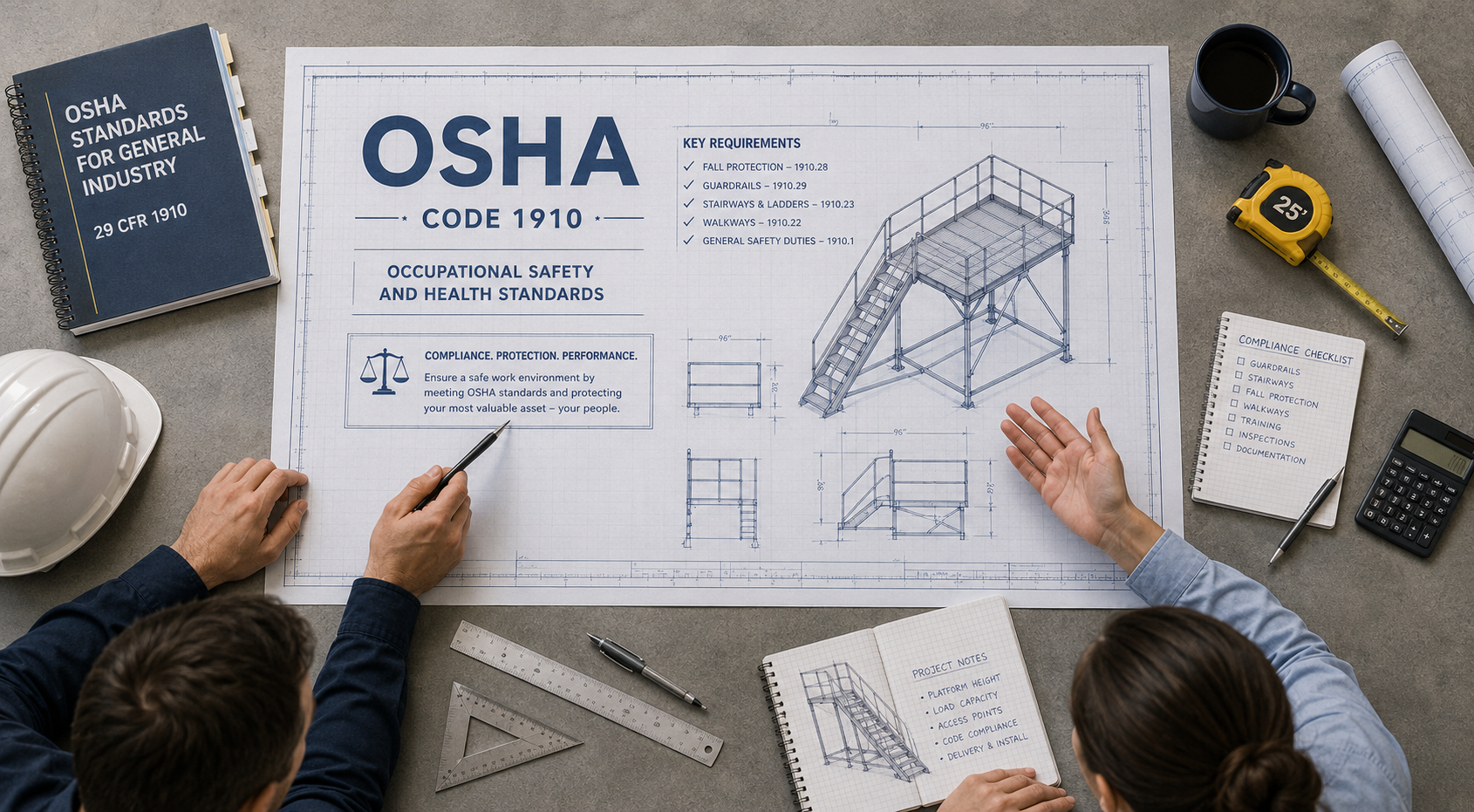
What OSHA Actually Requires Of You
Most of what gets called an OSHA question is really one of three separate questions, and mixing them up is where facilities get into trouble.
Does the equipment meet the dimensional and strength criteria. Does the employer have a program around it, meaning inspection, training, and documentation. And does anyone have the authority to stop work when something is wrong.
You can buy perfectly compliant equipment and still be cited on the second and third. That is the part manufacturers do not usually tell you, so we will.
This page is a working reference for the standards that apply to industrial access equipment. It is not legal advice and it does not replace reading the standard. Where a figure matters to a decision you are making, verify it against the current text at osha.gov.
Which Standard Applies To You
The first fork in the road, and people get it wrong regularly.
29 CFR 1910, General Industry. Manufacturing, warehousing, processing, maintenance, and most of what happens inside a facility on an ordinary day. Fall protection triggers at 4 feet.
29 CFR 1926, Construction. Construction, alteration, and repair work. Fall protection triggers at 6 feet.
The distinction is the activity, not the building. Your maintenance team servicing a production line is general industry work even if the plant is thirty years old and looks like a construction site. A contractor erecting new structural steel in that same plant on the same day is construction.
When both are happening in one facility, both apply to their respective crews. That catches people during expansions and retrofits.
The Subpart D Map
Walking-Working Surfaces is 29 CFR 1910 Subpart D. Here is what each section actually covers, so you know where to look.
| Section | Covers | Why it matters to you |
|---|---|---|
| 1910.21 | Scope and definitions | Defines terms like qualified person, low-slope roof, and walking-working surface |
| 1910.22 | General requirements | Surfaces kept clean and orderly, capable of supporting the maximum intended load, inspected regularly, and repaired before reuse |
| 1910.23 | Ladders | Portable and fixed ladder dimensions, condition, and use |
| 1910.24 | Step bolts and manhole steps | Narrow application, mostly utilities and towers |
| 1910.25 | Stairways | Standard, spiral, ship, and alternating tread stair geometry and strength |
| 1910.26 | Dockboards | Loading dock plates and levelers |
| 1910.27 | Scaffolds and rope descent systems | Points to the construction scaffold standard; rope descent anchorages |
| 1910.28 | Duty to have fall protection | The trigger heights and where protection is required. This is the duty section |
| 1910.29 | Fall protection criteria and practices | What a guardrail, gate, toeboard, or cover has to actually do. This is the specification section |
| 1910.30 | Training requirements | Who must be trained, on what, by whom, and when to retrain |
| 1910.140 | Personal fall protection systems | Harnesses, lanyards, anchorages, and arrest forces. Sits in Subpart I, not D |
The pairing to remember is 1910.28 and 1910.29. One tells you when you need protection. The other tells you what counts as protection. Reading either alone leads you somewhere wrong.
The Duty To Provide Fall Protection
Under 1910.28, protection is required at 4 feet above a lower level in general industry. Construction is 6 feet under 1926.501.
The duty also applies regardless of height in specific situations, including work above dangerous equipment and work near holes and openings. Height is the common trigger, not the only one.
Acceptable means of protection include guardrail systems, safety net systems, and personal fall protection systems. In practice, on fixed and mobile access equipment, guardrail is the right answer nearly every time, because it works whether or not anybody did anything that morning.
The Criteria, In Brief
Full detail on guardrail criteria and where systems fail in the field lives on our Platform Safety page. The figures themselves:
| Component | Requirement | Section |
|---|---|---|
| Guardrail top rail height | 42 inches, plus or minus 3 inches | 1910.29(b)(1) |
| Top rail strength | 200 lbf, downward or outward, within 2 inches of the top edge | 1910.29(b)(3) |
| Deflection limit under load | Not below 39 inches | 1910.29(b)(4) |
| Midrail | Midway to the surface, 150 lbf, unless a 21 inch wall or parapet exists | 1910.29(b)(2), (b)(5) |
| Maximum opening | 19 inches | 1910.29(b)(2) |
| Toeboard | 3.5 inches minimum, 0.25 inch maximum gap, 50 lbf | 1910.29(k) |
| Standard stair angle | 30 to 50 degrees | 1910.25(c)(1) |
| Riser and tread | 9.5 inch maximum riser, 9.5 inch minimum tread, uniform | 1910.25(c)(2), (c)(3) |
| Stair width and landing | 22 inches minimum width, landings 30 inches deep minimum | 1910.25(b)(4), (c)(4) |
| Stair strength | 5x live load, minimum 1,000 lb concentrated | 1910.25(b)(6) |
| Handrails required | 3 or more treads and 4 or more risers, 30 to 38 inches high | 1910.28(b)(11), 1910.29(f) |
| Fixed ladder rung spacing | 10 to 14 inches on center, uniform | 1910.23(b) |
| Fixed ladder width and clearance | 16 inch minimum width, 7 inch minimum behind rungs | 1910.23(b), (d)(2) |
| Fixed ladders over 24 feet | Ladder safety system or personal fall arrest system | 1910.28(b)(9) |
| Ladderway openings | Guardrail with self-closing gate, or offset entry | 1910.28(b)(3) |
The Employer Program, Which Is Where Citations Live
Equipment is the visible half. These are the requirements that sit on you regardless of who built the platform.
Load Capacity, 1910.22(b)
Every walking-working surface must be capable of supporting the maximum intended load. That means you need to know the rating and know what is actually going on the deck. A platform rated for two people that regularly holds two people and a 400 pound fixture is a problem the manufacturer cannot solve for you.
Inspection And Repair, 1910.22(d)
Surfaces must be inspected regularly and as necessary, hazardous conditions corrected before employees use the surface again, and repairs made by a qualified person where structural work is involved.
OSHA does not name an interval. That sounds like flexibility and it is actually a burden, because it means you have to be able to justify whatever interval you chose. Heavy daily use in a corrosive environment on a documented annual cycle is a hard position to defend.
Training, 1910.30
Employees exposed to fall hazards must be trained by a qualified person before exposure, in a language and vocabulary they understand.
Training has to cover the specific fall hazards in that work area and the correct use of the equipment you actually provided, not fall protection in general. Retraining is required when conditions change, when equipment changes, or when a worker shows they did not retain it.
Document who, when, on what, and by whom. Undocumented training is very difficult to prove after the fact.
Competent Person Authority
A competent person can identify existing and predictable hazards and has authorization to take prompt corrective measures. The second half is the half that gets skipped. Naming someone competent without giving them authority to stop work does not satisfy the definition.
What OSHA Does Not Require
A fair amount of what gets sold as an OSHA requirement is not one. Knowing the difference saves money and keeps you from arguing the wrong point during an inspection.
What Is And Is Not Grandfathered
This gets misunderstood in both directions. Some people assume everything old is exempt. Others assume everything has to be torn out.
Stairs installed before January 17, 2017 have a limited exception to the riser height and tread depth requirements in 1910.25(c)(2) and (c)(3). That exception is narrow and it is dimensional only.
Fixed ladders over 24 feet installed before November 19, 2018 may continue using cages or wells until November 18, 2036.
Nothing about load capacity, inspection, training, or general condition is grandfathered. An old platform still has to support its intended load, still has to be inspected, and still has to be repaired before use if something is wrong.
The Fixed Ladder Timeline
Worth its own section because the middle item catches almost everyone.
November 19, 2018. New fixed ladders over 24 feet required a ladder safety system or personal fall arrest system. Cages and wells no longer counted on their own.
The repair trigger, ongoing. Any portion of an existing ladder that is repaired or replaced must be equipped with a ladder safety system or personal fall arrest system at that time. Touching an old caged ladder starts the clock immediately. You do not get to wait until 2036 once you begin work on it.
November 18, 2036. Every remaining fixed ladder over 24 feet must comply. No exceptions after that date.
The practical takeaway: inventory your fixed ladders and note the height of each. Anything over 24 feet goes on a dated list, and anything already scheduled for repair moves to the top of it.
A Walk-Around Self-Audit
Not a substitute for a competent person evaluation. It will find the obvious problems in an afternoon.
- Every elevated surface over 4 feet has guardrail on all open sides
- Top rails do not flex noticeably under hand pressure
- Midrails are present, or a wall or parapet at least 21 inches high is
- No opening anywhere in a rail system exceeds 19 inches
- Toe boards are present wherever anyone or anything passes below
- No chains, ropes, or removable rail sections used in place of gates
- Every ladderway and stairway opening has a self-closing gate or an offset
- Stair risers and treads are uniform on every flight
- Handrails present on flights with 3 or more treads and 4 or more risers
- No fixed ladder over 24 feet relying on a cage alone
- Nothing encroaching on the 7 inch clearance behind fixed ladder rungs
- Rated capacity signage present and legible on every platform
- No visible cracked welds, corroded members, or loose base anchors
- Nothing stored on a work platform that was not designed for storage
- Inspection records exist and show a defensible interval
- Training records exist, name the equipment, and are current
- A competent person is named and has authority to stop work
Anything you cannot check off is worth a conversation before it is worth a purchase order.
Frequently Asked Questions
Which OSHA standard applies to industrial work platforms?
For general industry, 29 CFR 1910 Subpart D covers walking-working surfaces, ladders, stairways, and fall protection. Construction work falls under 29 CFR 1926 Subpart M. The distinction is the activity being performed, not the type of building.
At what height does OSHA require fall protection?
Four feet above a lower level in general industry under 1910.28(b)(1), six feet in construction under 1926.501(b)(1). Protection is also required regardless of height in specific situations, including work above dangerous equipment.
Does OSHA require a PE stamp on a platform?
Generally no. PE stamps are typically required by local building departments, corporate engineering standards, insurers, or seismic and high-wind review requirements. We can provide stamped drawings when a project needs them, and you should tell us early because the review cycle happens before fabrication starts.
Is our existing equipment grandfathered?
Only in narrow, dated cases. Stairs installed before January 17, 2017 have a limited exception on riser and tread dimensions. Fixed ladders over 24 feet installed before November 19, 2018 may use cages until November 18, 2036. Load capacity, inspection, training, and general condition requirements are not grandfathered at all.
Who is responsible for compliance, us or the manufacturer?
The employer. A manufacturer designs and builds to the standard and states the rating. The duty to provide compliant surfaces, inspect them, train workers, and maintain a fall protection program sits with you under 29 CFR 1910. Buying compliant equipment is necessary but not sufficient.
How often do we have to inspect our platforms?
1910.22(d) requires regular inspection and inspection as necessary, with hazardous conditions corrected before the surface is used again. OSHA does not name an interval, which means you have to be able to justify the one you chose based on how heavily the equipment is used and how corrosive the environment is.
What has to be covered in fall protection training?
Under 1910.30, a qualified person must train exposed employees before exposure, in a language and vocabulary they understand, on the specific fall hazards in that work area and the correct use of the equipment provided. Retrain when conditions change, equipment changes, or a worker demonstrates inadequate understanding.
Can we use a chain across a ladder opening?
In practical terms, no. A chain will not hold 200 pounds without deflecting below 39 inches and it leaves an opening well over the 19 inch maximum. Use a self-closing gate or an offset entry.
Are spiral or ship stairs allowed?
Only where the employer can demonstrate a standard stair is not feasible. Standard stairs are the default under 1910.25. We do not build spiral stairs, and in nearly every case a switchback or multi-landing stair fits the same footprint.
What is a qualified person versus a competent person?
A qualified person has a recognized degree, certificate, professional standing, or demonstrated knowledge and experience to solve problems relating to the subject matter. A competent person identifies hazards and has authority to take prompt corrective action. Training under 1910.30 requires a qualified person. Stopping unsafe work requires a competent person.
Do fixed ladder cages still count as fall protection?
Not on their own. Ladders over 24 feet need a ladder safety system or personal fall arrest system. Ladders installed on or after November 19, 2018 had to comply immediately, any repaired portion triggers it now, and everything remaining must comply by November 18, 2036.
Does OSHA certify or approve equipment?
No. There is no such thing as an OSHA certified platform or an OSHA approved ladder. A manufacturer can design and build to the standard and tell you so. Anyone offering you an OSHA stamp of approval is describing something that does not exist.
Where We Fit
We design and build to the standard rather than around it, and we tell you plainly what a piece of equipment is rated for. That covers the equipment half.
On the program half, we will tell you what we know and where the line is. We are not a safety consultancy and we will not pretend an equipment purchase resolves an inspection, training, or documentation gap. When your situation calls for a competent person evaluation or a legal opinion, that is what it calls for.
If you are working through an access problem and want a second set of eyes on whether the solution actually meets the standard, call us at 888-864-9853. That conversation is free and it is usually shorter than people expect.
Reference Resources
- OSHA Walking-Working Surfaces
- OSHA Fall Protection
- 29 CFR 1910 full text
- 29 CFR 1926 full text
- ANSI Standards Information
Disclaimer
This page is provided for general awareness and informational purposes only. It is not legal advice, it is not a substitute for the text of the standards, and it does not replace employer safety programs, competent person evaluations, or engineering review.
Standards change. Figures cited here should be verified against the current text at osha.gov before being relied on for a compliance decision. State plans may impose requirements more stringent than federal OSHA.
Users are responsible for ensuring that all work practices, equipment, platforms, and fall protection systems comply with applicable federal, state, local, and site-specific requirements.