
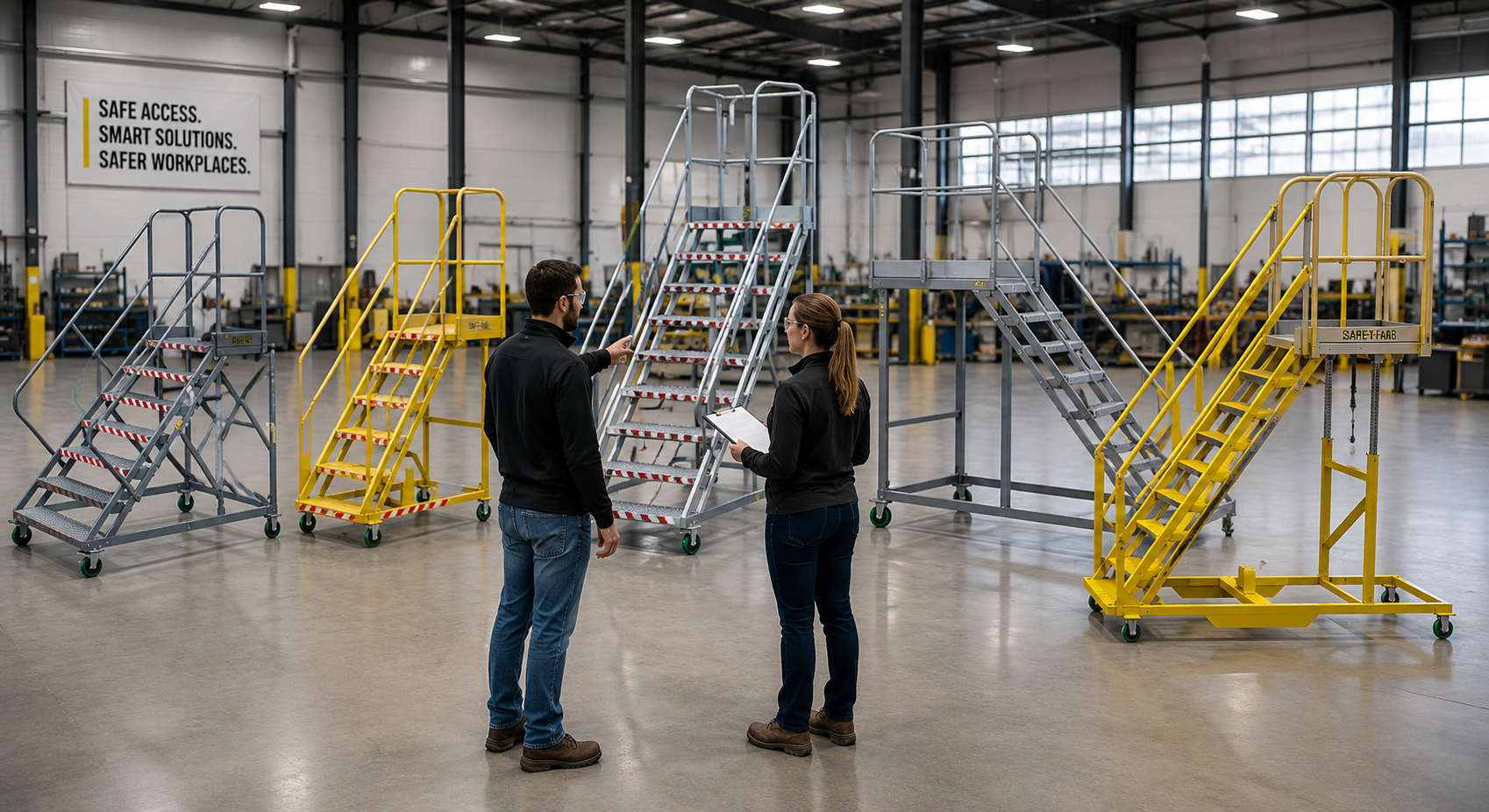
Getting People To The Work Safely
Industrial maintenance access is the equipment that gets your people to the service points on machinery, tanks, conveyors, rooftop units, and vehicles. Fixed and mobile platforms, cantilever platforms, crossovers, stairs, and ladders, designed around the actual service procedure rather than around a height on a drawing.
It is the least glamorous category of equipment in a plant and one of the most consequential, because bad access does not announce itself. It just quietly makes every job on that asset take longer, every year, for as long as you own it.
What Bad Access Actually Costs
Setup time before the work starts. Finding the lift, charging it, moving product out of the way, getting a second person. On a fifteen minute job that happens weekly, twenty minutes of setup is not a rounding error.
A second person who was not needed. Ladder work often requires a spotter. That is two people tied up for a one-person task.
Scheduling dependency. If the job needs a lift and the lift is on the other end of the plant or out for service, the work waits. Now maintenance is scheduled around equipment availability instead of around production.
Deferred preventive maintenance. This is the expensive one. When getting to a service point is a project, inspections get pushed. Planned service turns into unplanned failure, and unplanned failure costs several times what the PM would have.
Workarounds. People climb on the machine. They stand on the guardrail. They reach from a ladder positioned two feet too far away. Nobody decides to do this. It happens because the safe route is inconvenient and the job still has to get done.
That last one is the tell. When people bypass the access you provided, the access was the problem.
Signs Your Access Is The Bottleneck
Walk your floor and look for these. Every one of them is a solvable design problem.
- A lift or ladder gets brought out for the same task every week
- Technicians climb on equipment, railings, or product to reach a service point
- A two-person job that should take one person
- PM tasks on a specific asset are routinely deferred or skipped
- People walk the long way around a conveyor rather than crossing it
- Somebody has laid a plank, pallet, or piece of grating to bridge a gap
- Work at a service point happens from an awkward, extended reach
- A platform exists but is the wrong height, so people stand on something
- Access requires moving product or shutting a line that would not otherwise stop
- New technicians need to be shown a trick to reach something
- The same asset shows up repeatedly in near-miss reports
That last item is worth taking seriously. Near misses cluster around access problems long before an injury does.
The Reframe That Helps
Access equipment gets evaluated as a capital purchase against its price. It behaves more like a fixed reduction in the labor time of every future job on that asset.
A service point visited weekly for ten years is roughly 500 visits. Fifteen minutes saved per visit is 125 hours. That math does not appear on a quote, and it is usually the whole argument.
Access Problems We Solve Most Often
Machine Access
Service points on top of or behind a machine, usually reached today with a ladder or by climbing on the frame.
The design question is not just how high. It is what the technician does when they get there. Reading a gauge needs a small deck. Pulling a 90 pound motor needs a deck sized for two people, a clear path to set the part down, and enough guardrail spacing that nobody is leaning over a rail with weight in their hands.
Where the machine shape gets in the way, a cantilever platform reaches over it with no legs underneath.
Conveyor And Line Crossing
People stepping over a conveyor, or walking a hundred feet to the end of the line to get around it. Both cost you, one in risk and one in time.
A crossover is a stair up, a landing across, and a stair down. Sized to the clearance required beneath, the traffic crossing above, and whether anyone is carrying anything.
Tank And Vessel Access
Top-of-tank service, sampling, gauging, and hatch access. This is where the stair-versus-ladder decision matters most, because people almost always carry something up a tank. Samples, instruments, tools.
For any tank serviced regularly, a stair with continuous guardrail beats a ladder. Where a ladder is unavoidable and the climb exceeds 24 feet, OSHA requires a ladder safety system or personal fall arrest system.
Corrosion drives material choice here more than anywhere else in a plant. Tell us what is in the tank and what it does to the air around it.
Rooftop HVAC And Utility Access
Rooftop work has a path problem as much as a platform problem. The technician has to get from the hatch or ladder to the unit, over ducts and curbs, without walking on the membrane and without getting near an unprotected edge.
Usually that means a walkway system, one or more crossovers, and guardrail or a platform at any unit near the edge. Solve the path, not just the destination.
Truck, Trailer, And Railcar Access
Loading, inspection, tarping, and top-of-load work. The challenge is reaching over a sidewall or across a bed without anything underneath, and doing it at a height that varies with the vehicle.
A side cantilever reaches out over the sidewall. Where vehicle heights vary, an adjustable height mobile stair handles the range without a separate unit for each.
Aircraft And Rotorcraft
Contour access where the platform has to follow a curved surface at a controlled standoff distance. Nose, wing, engine, tail, and rotor head.
This is a large part of our work and it is the clearest case for full custom design. Detail on fixed wing and rotorcraft access.
Overhead And Utility Runs
Lighting, sprinkler heads, cable tray, and pipe runs at height. Usually the right answer is a mobile platform sized to reach the run, because the work moves along the length of the building rather than sitting in one place.
Fixed Or Mobile
| Situation | Usually the better fit |
|---|---|
| Same service point, regular schedule | Fixed platform |
| Several machines at similar heights | Mobile platform or adjustable height stair |
| The aisle has to stay clear | Mobile, rolled out when not in use |
| Work moves along a line or a run | Mobile |
| Heavy loads or long cantilever reach | Fixed, anchored |
| Layout changes every year or two | Mobile, or fixed and bolt-together modular |
| Access needed during an emergency or upset | Fixed, always in place |
The question that settles most of these: if the platform is not there when somebody needs it, what do they do instead? If the honest answer is climb on something, put it there permanently.
Design Around The Procedure, Not The Height
Height is the easy input and it is rarely the thing that determines whether a platform gets used. What the technician does at the top decides that.
Watch The Job Before You Specify The Platform
Ten minutes standing next to somebody doing the task tells you more than an hour in a conference room. You are watching for four things.
Where the hands need to be. Working height gets measured to the top of the machine and it should be measured to where the hands work. Six inches off and the platform is uncomfortable for the next fifteen years.
What gets set down. Parts, covers, fasteners, tools. If there is nowhere to put them, they end up on the deck edge or in a pocket, and both create problems. Deck size and toe board placement follow from this.
Which direction they face and lean. Guardrail is supposed to protect the work position, not fight it. A rail placed exactly where the technician needs to lean is a rail that gets climbed over.
What has to stay reachable. Access panels, lube points, gauges, disconnects, drain valves. Blocking the thing the platform was built to reach is a real and common failure, and it is entirely avoidable if somebody says it out loud at concept stage.
Access And Egress Come From The Traffic
Put the stair where people actually approach from, not where it fit in the layout. If reaching the stair means routing through a forklift aisle or around a machine, people will find a shorter way up.
On longer platforms, consider two access points. A single stair at one end means anyone past the halfway mark walks toward a problem to get away from it.
Retrofitting Into A Running Plant
Most of our work is retrofit, not greenfield. That brings constraints that do not exist on a new line.
The floor is not the drawing. Drains, slope, expansion joints, and equipment that moved two years ago and never made it onto the plan. We design from photos and field dimensions for this reason.
Anchoring may not be allowed. Post-tension slabs, in-slab conduit, tenant restrictions, or a facilities group that simply says no. Freestanding designs solve this at the cost of a wider base.
Installation windows are short. If the platform can only go in during a two-day shutdown, that shapes the design. Bolt-together sections that a two-person crew can assemble in sequence beat a single large weldment that needs a crane and a hot work permit.
Overhead is crowded. Sprinklers, lighting, cable tray, crane hook height. Clearance above the platform is as much a constraint as the footprint below it.
It has to get in the building. Roll-up door height, personnel door width, aisle turns. Send us the tightest point on the path from the truck to the final location.
Access Is A Downtime Decision
Two ways access affects uptime, and they pull in opposite directions.
Repair time. Better access shortens every repair on that asset. That effect compounds over the life of the equipment and it is the easier one to justify.
Installation downtime. Putting the access in costs you a window now. That is a one-time cost and it is the one that gets weighed against an indefinite series of small ones.
Designing for a short install window is a real engineering constraint and we treat it as one. Modular sections, bolted connections, and a defined assembly sequence exist to shrink that window, not just to make shipping cheaper.
What To Send Us
Enough to have a real conversation, not a complete specification.
- Photos of the area from four to six angles, including one wide shot
- The working height to the service point, measured to where hands work
- The floor footprint available, and what cannot be blocked
- Overhead clearance
- What the technician does and carries at the service point
- How many people work there at once
- How often the task happens
- The environment, including washdown, chemical, or outdoor exposure
- Whether anchoring into the floor is permitted
- Any panels or access points that must stay reachable
If you do not have all of it, send what you have. A phone photo and a rough height starts a useful conversation faster than waiting for a complete survey.
Call us at 888-864-9853, or see how our design process works.
Frequently Asked Questions
What counts as industrial maintenance access?
Any permanent or mobile equipment that gets maintenance personnel safely to a service point. Fixed and mobile platforms, cantilever platforms, crossovers, industrial stairs, and fixed ladders. What separates maintenance access from generic access equipment is that it gets designed around a specific service procedure rather than around a height.
Should we use a fixed platform or a mobile one?
Fixed for a service point visited on a regular schedule that stays in one place. Mobile when a crew services several machines at similar heights, when the aisle has to stay clear, or when the work moves along a line. If the honest answer to "what happens when the platform is not there" is that somebody climbs on something, make it fixed.
Can a platform be built around our existing machinery?
Yes, and most of our work is exactly that. We design platforms to conform to irregular machine shapes, wrap around obstructions, and cantilever over equipment where no legs can be placed. Photos, working height, footprint, and the location of the service points are usually enough to develop a concept.
How do we get people over a conveyor safely?
A crossover. Stair up, landing across, stair down. It is sized to the clearance needed beneath, the traffic crossing above, and whether anyone is carrying anything. Stepping over a running conveyor and walking a hundred feet to the end of the line are both worse answers.
What is the safest way to access the top of a tank?
A fixed stair or platform with continuous guardrail for any tank serviced regularly, because people carry tools, samples, and instruments up. Where a ladder is unavoidable and the climb exceeds 24 feet, OSHA requires a ladder safety system or personal fall arrest system. Tell us what is in the tank, since corrosion drives material selection here more than anywhere else.
Is a scissor lift good enough instead of dedicated access?
A lift is flexible, and it adds setup time to every single visit. It needs a trained operator, it needs charging, it has to be scheduled, and it occupies aisle space while in use. For a service point on a regular schedule, dedicated access is faster per visit and removes the scheduling dependency. For occasional work in unpredictable locations, the lift is the right tool.
How much floor space will we lose?
Less than most people assume, and it depends on the access method. A stair at 30 to 50 degrees needs roughly a foot of run per foot of rise. Freestanding units need a wider base than anchored ones. When space is genuinely tight, switchback stairs, cantilever designs, and anchoring are the tools we reach for before giving up on a stair.
Can access be installed during a short shutdown?
Yes, and telling us the length of your window changes the design. Modular bolt-together sections that a two-person crew can assemble in sequence go in far faster than a single large weldment needing a crane and a hot work permit. Design for the window rather than discovering it late.
What if we cannot anchor into the floor?
Freestanding designs solve it. They need a wider base and more steel to stay stable, and there is a practical limit on height and cantilever reach, but they keep your slab intact and stay relocatable. Post-tension slabs, in-slab conduit, and tenant restrictions all make this the right call regularly.
How do we justify the cost internally?
Count the visits. A service point worked weekly for ten years is roughly 500 visits. Multiply the setup time you save per visit and compare that against the quote. Then add the value of PM tasks that stop getting deferred, which is usually the larger number and the harder one to put on a spreadsheet.
Where To Start
Pick the one asset your maintenance team complains about most. That is almost always an access problem wearing a different label.
Send us photos and a rough working height and we will tell you what we would do. If it is a bad fit for us, we will say that too.
888-864-9853